
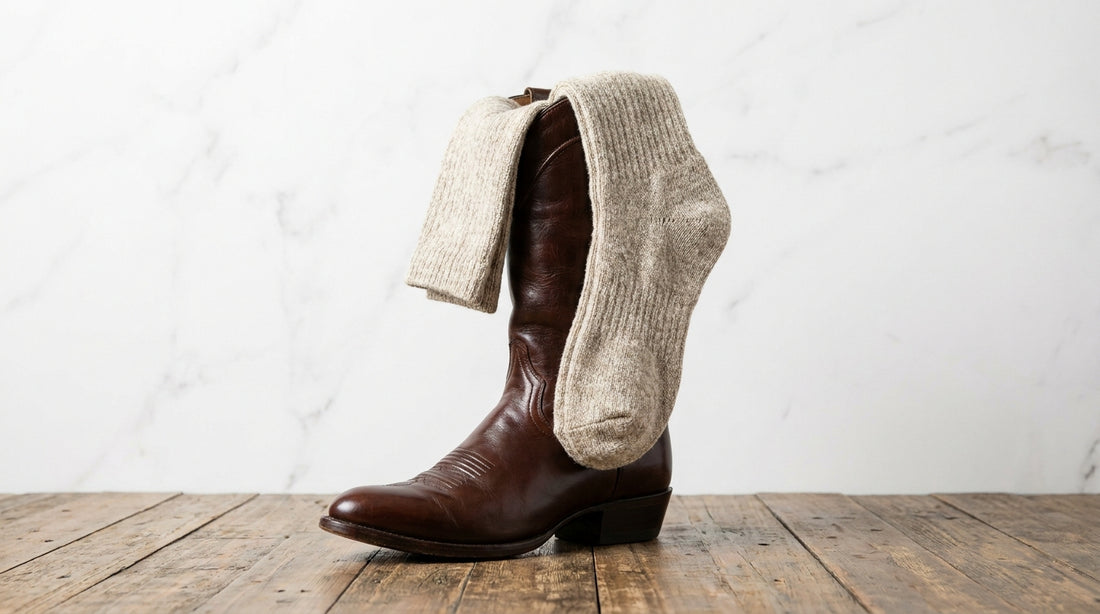
Best Socks for Breaking in Cowboy Boots: The 14-Day Phase Guide
You bought new cowboy boots — congratulations. Now comes the part most people don't anticipate: the first two weeks. Stiff leather, hot spots on the inner ankle, and heel blisters that show up before the boots look remotely worn in. The question isn't whether you'll feel it. The question is whether the right socks can make it survivable.
They can — but not all socks work the same way at every stage. DeadSoxy has shipped over 2 million pairs of socks over 13 years, and the cowboy boot break-in question comes up constantly. Most people wear the wrong sock at the wrong time. This guide gives you a phased approach: which socks to wear in Days 1–4, Days 5–10, and Days 11–14, and why the strategy shifts as the leather softens.
If you're starting from scratch, the fuller question of whether socks are even necessary with cowboy boots has a definitive answer — and it matters for everything that follows.
TL;DR: The best socks for breaking in cowboy boots are mid-weight merino wool, over-the-calf length, with reinforced heels and toes. Start heavy in Days 1–4 for protection, shift to medium weight in Days 5–10 as the boot molds to your foot, then transition to your everyday sock weight by Day 11. Phasing your sock weight to match leather softening cuts blisters and shortens the break-in timeline.
What Makes Break-In Socks Different From Everyday Cowboy Boot Wear
- The cowboy boot break-in period
- The break-in period is the 2–4 week window during which new leather cowboy boots soften, flex, and begin conforming to the wearer's foot shape. Proper sock selection during this window reduces friction, prevents blisters, and can meaningfully shorten the total timeline before the boots feel like yours.
Everyday cowboy boot wear asks a lot from your socks: moisture control, shaft protection, comfort through a full day. Break-in wear asks for something more strategic — targeted padding in the right zones at the right time, in the right sequence.
During break-in, leather is at its stiffest. The heel cup hasn't settled into your heel shape yet. The shaft hasn't bent to your calf angle. The toe box is pinching at its tightest. Your sock is the only buffer between that rigid structure and your skin — and the wrong buffer creates more problems than it solves.
A sock that's too thin leaves you unprotected in Phase 1. A sock that stays too thick throughout the whole process trains the boot to mold around a padded foot, not your actual foot. When you finally switch to your normal sock, the boot feels sloppy. The phase approach solves both.
The 14-Day Break-In Phase Guide
Every cowboy boot break-in is different — leather quality, construction, and your foot shape all factor in. But the phase logic holds across nearly every pair of quality leather boots: start heavy, shift to medium, finish at your everyday weight.
Phase 1 — Days 1–4: The Buffer Phase
The boot is at maximum stiffness. Your goal during this phase isn't to stretch the leather — it's to protect your skin while the leather begins its first softening cycle. Wear the heaviest over-the-calf merino wool sock you own. The cushioning should cover the entire heel and run through the toe box.
Keep early wear sessions to 2–3 hours. The leather needs to flex under load, not be punished with a full day on foot immediately. If hot spots develop on your heel or the inner ankle bone, note where they are — that's the boot showing you its tightest points, which tells you where to focus in Phase 2.
Phase 2 — Days 5–10: The Molding Phase
The leather has started to soften. This is where the actual foot-profile molding happens — and where most people make the mistake of staying in their thick Phase 1 socks too long. Heavy socks at this stage mean the boot molds around a padded foot profile, not your real one. When you eventually switch to your everyday sock, the fit will feel off.
Switch to medium-weight merino wool. The boot should feel snug but not painful. Some compression is appropriate here — that's the leather working against your actual foot shape. Over-the-calf length still matters for shaft protection during this phase.
Phase 3 — Days 11–14: The Transition Phase
The boot is nearly broken in. Switch to the sock weight you intend to wear every day going forward. If that's lightweight merino or a medium-weight bamboo sock, wear it now. The final days of break-in should happen in your real sock — that's the profile the boot will ultimately conform to.
Why Sock Material Matters More During Break-In
Cotton fails first. New leather traps heat and moisture more aggressively than worn leather — the boot hasn't had time to develop the breathability it will eventually have. Cotton absorbs moisture and holds it against your skin, which softens the skin and raises blister risk exactly when the boot is at its most abrasive.
Merino wool manages moisture by absorbing up to 35% of its own weight while still feeling dry to the touch. According to The Woolmark Company, merino fibers absorb moisture vapor from the skin before it turns to sweat — making it the best natural fiber choice for the enclosed, high-friction environment of a new leather boot. It also regulates temperature better than synthetics, which matters during longer break-in wear sessions.
Bamboo is a strong alternative. DeadSoxy's Bamboo fabric absorbs 60% more moisture than cotton, which makes it effective in the early phases when friction is generating more heat inside the boot. For riders in warm climates, a heavy Bamboo over-the-calf sock can match or exceed merino performance in Phase 1.
Expert Tip: Avoid athletic socks during break-in. The arch support bar in most athletic socks competes with the boot's own structure, and the synthetic cushioning is concentrated in the wrong zones for cowboy boot wear. Use over-the-calf wool socks designed for boot wear — the cushioning placement is different, and the length keeps the shaft zone protected.
DeadSoxy socks are made on Italian-made Lonati knitting machines with OEKO-TEX Standard 100 certified materials. During break-in, material quality matters beyond comfort: lower-grade wool blends lose shape faster under the compression of new leather, which creates bunching inside the boot and additional friction points you don't need during an already abrasive process.
For a full material comparison, the Thin vs. Thick Socks for Cowboy Boots guide breaks down every weight and fiber combination for western boot wear.
The Double-Sock Technique
The double-sock method is often referenced as a boot-stretching hack, but its real value is blister prevention. Wear a thin moisture-wicking liner against your skin — lightweight cotton or a synthetic blend works — with your Phase 1 heavy merino sock over it. When your foot moves inside the boot, friction happens between the two sock layers, not between sock and skin.
The outer-to-inner friction absorbs the abrasion that would otherwise grind against your heel and ankle directly. For people with narrow heels who experience significant heel slip in new boots, this technique reduces the piston effect that causes heel blisters more than almost any other adjustment.
"When your foot moves inside the boot, friction happens between sock layers — not between sock and skin."
Limit the double-sock method to Phase 1 (Days 1–4). By Phase 2, you want a single sock so the boot learns your actual foot profile. Two layers during the molding phase distort the profile. The double-sock is a short-term blister shield — not a permanent strategy, and not needed once the leather begins to soften.
When to Size Up: Reading Fit During Break-In
Cowboy boots fit differently than athletic shoes — there's intentional heel slip at first, and the toe box is typically snug before it softens. The sizing question comes up often during break-in, and the rule is straightforward: size your boot to your actual foot wearing your intended everyday sock, not your break-in sock.
If the toe box remains uncomfortably tight after 5 or more days of proper break-in, a half-size up may be appropriate. Test it with a thin sock and check the fit — if it feels right, that half-size gives you breathing room while still allowing a proper mold over 14 days. If the boot feels loose even in a thin sock, you've sized too large.
Shaft tightness is different. Some calf compression early in break-in is normal and resolves as the leather flexes. If the shaft is restricting circulation after Day 7 even in a medium-weight sock, that's a fit issue, not a break-in issue.
How to Protect Your Heels and Toes During Break-In
The heel and toe box are the two highest-risk zones in cowboy boot break-in. The heel because the quarter panel is at its stiffest, creating a grinding motion on every step before the heel cup forms. The toe box because it's at its tightest when leather is new, creating lateral and vertical compression that compounds over a full wear session.
Over-the-calf merino socks with reinforced heels and toes address both zones structurally. The reinforced heel section provides additional material thickness exactly where new leather is grinding hardest. The reinforced toe area prevents the wool from thinning under toe pressure — which would eliminate your buffer precisely where you need it most.
Pro Tip: Apply a thin layer of leather conditioner to the heel quarter and the vamp of the boot before your first wear. Conditioned leather softens faster and creates fewer sharp friction edges during Phase 1. The sock protects your skin — the conditioner helps the leather meet you halfway.
DeadSoxy socks feature reinforced heels and toes built for long-term durability. During break-in, that structural reinforcement does double duty — protecting your feet through 14 days of heavy use while producing socks that last 12+ months of regular wear afterward. Your break-in pair is your everyday pair.
Key Data: The American Podiatric Medical Association (APMA) identifies friction blisters as among the most preventable foot injuries — and notes that protective layers between skin and a hard surface are the primary prevention method. Sock selection is structural blister prevention, not just a comfort decision.
For a full protocol covering blister prevention inside leather boots, see How to Prevent Blisters in Cowboy Boots.
After Break-In: Transitioning to Your Everyday Sock
By Day 14, your boot should feel noticeably more pliable. The heel cup has started forming. The shaft bends with your calf instead of against it. The toe box has softened enough to stop feeling tight. The sock strategy shifts at this point from protection to maintenance and comfort.
For everyday cowboy boot wear, over-the-calf length remains the right call. It protects the shaft zone, prevents the leg-rubbing that comes from mid-calf socks slipping down inside tall boots, and gives full coverage whether you're at a desk or in the saddle. Medium-weight merino is the standard for most climates. For hot-weather wear, lightweight Bamboo over-the-calf socks are the call.
For the full breakdown of everyday material selection, sock height, and cowboy boot care, see Best Socks for Cowboy Boots — and for the complete master guide covering every boot type, see Boot Socks: Complete Guide for Every Boot Type.
KEY TAKEAWAYS
- Use a heavy over-the-calf merino sock in Days 1–4 for maximum protection during the stiffest phase of leather break-in.
- Switch to medium-weight merino in Days 5–10 so the boot molds to your real foot profile, not a padded one.
- Transition to your everyday sock weight by Day 11 — the final mold happens in the sock you'll actually wear.
- The double-sock technique (thin liner + heavy outer) redirects friction between sock layers in Phase 1 — limit it to Days 1–4.
- Reinforced heels and toes matter during break-in — they protect exactly where new leather is hardest, and last well beyond the process.
The Bottom Line
Breaking in cowboy boots is a process, and your socks are part of that process — not just a comfort accessory. The 14-day phase guide gives you a thick-to-thin progression that protects your skin during the worst of it, then lets the leather mold to your actual foot shape during the critical molding window. Combined with the right material, reinforced construction, and the double-sock technique in the first days, the break-in window becomes manageable.
DeadSoxy has been making socks for over 13 years with more than 2 million pairs shipped. Every pair comes with a 111-day wear-and-wash guarantee — love them or get your money back. That includes the pair you're using for break-in.
Ready to gear up? Shop boot socks at DeadSoxy or start with the full resource: Boot Socks: Complete Guide for Every Boot Type.
Related Topics from Across DeadSoxy
- Best Socks for Work Boots: What to Look For in 2026
- Groom Wedding Day Socks: The Perfect Gift from Bride to Groom
- Game Day Ready: How Ole Miss Fans Are Elevating Their Sock Game
Frequently Asked Questions
Click any question below to expand the answer.
See also: Boot Socks: Complete Guide | Thin vs. Thick Socks for Cowboy Boots | How to Prevent Blisters in Cowboy Boots | Best Socks for Cowboy Boots
You might also like


Written by
Jason Simmons
Jason Simmons has been obsessed with socks since he founded DeadSoxy in Dallas, Texas in 2013 — convinced that the most overlooked item in a man's wardrobe was also the easiest upgrade. A Clarksdale, Mississippi native and Ole Miss alum, he now works with brands, retailers, and wedding parties on private label and custom sock programs, personally overseeing everything from fiber selection to final packaging. When he's not nerding out over merino blends, he's probably talking about Ole Miss football.


