
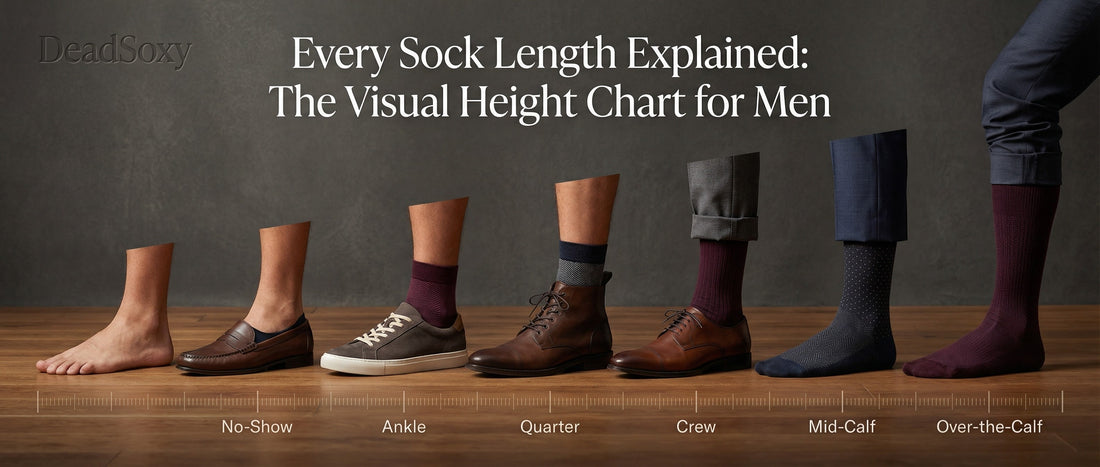
Every Sock Length Explained: The Visual Height Chart for Men
Sock length is one of the most consequential style decisions men make daily — and one they rarely think about. The wrong sock height creates visible gaps of bare leg when you cross your legs, causes socks to bunch awkwardly around the ankle, or looks jarringly out of place with certain shoe types. The right length? Invisible. It just works.
This guide walks through every standard sock height available for men, explains what each is designed for, and maps them to specific shoes and occasions so you never have to guess again.
TL;DR: There are five standard sock lengths for men — no-show, ankle, quarter, crew, and over-the-calf. No-shows create a sockless look with loafers and sneakers. Ankle socks are strictly athletic. Crew socks are the versatile all-rounder for business casual. Over-the-calf socks are mandatory for suits and formal wear because they never expose bare leg. The universal rule: match sock height to the formality of your outfit, and always reach above any boot shaft.
- What are the different sock lengths and when should you wear each?
- The five standard sock lengths for men each serve a specific purpose — no-show socks (below ankle, 1–2 inches) create a sockless appearance with loafers, boat shoes, and sneakers in casual warm-weather settings; ankle socks (3–4 inches) are strictly for athletic shoes and gym sessions; quarter-length socks (4–6 inches) cover the ankle bone for cross-training shoes and casual chukka boots; crew socks (6–8 inches, mid-calf) are the versatile standard for business casual through smart casual with dress shoes, Chelsea boots, and work boots; and over-the-calf socks (14–18 inches, below knee) are the non-negotiable choice for suits, tuxedos, and all formal business attire because they never expose bare leg when seated or crossing legs — with the universal rule being that sock height should always match or exceed the formality of the outfit and reach above any boot shaft to prevent skin-on-leather friction.
The Complete Sock Height Spectrum
No-Show / Invisible Socks (Below Ankle)
Height: Sits below the shoe line, typically 1–2 inches from sole to top edge.
No-show socks are designed to be completely hidden inside the shoe, giving the appearance of going sockless while still providing a moisture barrier between your foot and the shoe's interior. They're cut low with silicone grip strips on the heel to prevent slipping down during wear.
Best paired with:
- Loafers and driving shoes
- Canvas sneakers and slip-ons
- Boat shoes and deck shoes
- Espadrilles
When to wear them: Casual settings, warm weather, any outfit where showing ankle is intentional — typically with shorts, cropped trousers, or cuffed chinos. No-show socks are never appropriate with suits or business formal attire.
Common problems: Cheap no-show socks slip off the heel constantly. Look for silicone grip pads (not just a single strip but full heel coverage) and a deeper cut across the toe box that still stays hidden below the shoe opening. For a deeper dive into what separates great no-show socks from the rest, see our complete guide to no-show socks.
Expert Tip: The number one reason no-show socks slip is poor heel grip construction. DeadSoxy's TrueStay™ technology uses a full-coverage silicone grip panel — not just a single strip — that anchors the sock to your heel throughout the day. If your no-shows are constantly bunching under your arch, upgrading the grip system solves the problem permanently without switching to a taller sock length.

Ankle Socks (Ankle Bone Height)
Height: Rises to just below or at the ankle bone, approximately 3–4 inches from sole to top.
Ankle socks sit right at the top of the shoe, showing a thin band of sock between the shoe collar and trouser hem. They're the most common sock length for athletic and casual wear.
Best paired with:
- Running shoes and athletic trainers
- Low-top sneakers
- Casual boots (minimally visible)
When to wear them: Gym sessions, running, casual weekends. Ankle socks are purely athletic or casual — they have no place in professional or formal wardrobes. The visible sliver of sock above the shoe creates a truncated visual line that breaks the leg silhouette. Our ankle socks guide covers when this length works and when to size up.

Quarter-Length Socks (Above Ankle)
Height: 4–6 inches from sole, rising about one-quarter of the way up the calf.
Quarter socks bridge the gap between ankle and crew. They cover the ankle bone completely and extend a couple of inches above it, providing more coverage without the full height of a crew sock. This is an increasingly popular length for casual wear and athletic cross-training.
Best paired with:
- Mid-top sneakers
- Hiking shoes
- Cross-training shoes
- Casual chukka boots
When to wear them: Active casual situations where you want more coverage than an ankle sock provides but don't need a full crew. The quarter length works well with joggers, athletic pants, and casual trousers that sit above the shoe top.
Crew Socks (Mid-Calf)
Height: 6–8 inches from sole, hitting approximately mid-calf.
Crew socks are the Swiss Army knife of sock heights — versatile enough for casual, business casual, and many professional contexts. They provide substantial calf coverage, stay up reliably (gravity works in their favor at this height), and create a clean visual line under trousers.
Best paired with:
- Oxford and derby dress shoes
- Chelsea boots
- Work boots
- High-top sneakers
- Most casual and dress shoes
When to wear them: Business casual environments, smart casual outfits, and any situation where your socks might be briefly visible when you sit down. Crew socks are the minimum acceptable length for business attire — they prevent bare leg from showing when trousers ride up. For a full breakdown of this versatile length, read our crew socks guide.

Over-the-Calf / Knee-High Socks (Below Knee)
Height: 14–18 inches from sole, extending to just below the knee.
Over-the-calf (OTC) socks are the gold standard for formal and professional dress. They function like long stockings — held up by elastic tension along the full length of the calf, they never sag, never bunch, and never expose bare leg regardless of how you sit, cross your legs, or move throughout the day.
Best paired with:
- Suit trousers and formal wear
- Tuxedos and black tie
- Business formal office environments
- Traditional dress shoes
When to wear them: Any time you wear a suit. Period. OTC socks eliminate the embarrassment of flashing a strip of hairy calf during a board meeting or client presentation. They're also the choice for tall men whose trousers ride up more than average when seated.
For more on building a proper professional sock wardrobe with the right heights, see our professional man's guide to dress socks.

The Cardinal Rule: Match Height to Occasion
The simplest framework for sock height selection:
- Formal / business formal: Over-the-calf, always. No exceptions.
- Business casual: Crew minimum. OTC if you want polish.
- Smart casual: Crew is the sweet spot.
- Casual: Quarter or crew depending on the shoe.
- Athletic: Ankle or quarter, matched to shoe height.
- Sockless look: No-show — never actually barefoot in shoes.
Sock Length and Shoe Pairing Quick Reference
- Oxfords / Derbys: OTC (formal) or Crew (business casual)
- Loafers: No-show (sockless look) or Crew (covered look)
- Chelsea Boots: Crew or OTC — must reach above boot top
- Sneakers (low): No-show, ankle, or crew depending on outfit
- Sneakers (high-top): Crew — must be taller than the shoe
- Boots (work/hiking): Crew or OTC — must reach well above boot shaft
- Sandals: None. Socks with sandals is a deliberate style choice with very specific execution rules, not a casual decision.
Our guide to matching socks with suits covers color and pattern pairing alongside height recommendations for professional environments.
Expert Tip: Sock height labels are inconsistent across brands — one brand's "crew" may be another's "quarter." Always check the actual measurement in inches from heel to cuff top before buying. At DeadSoxy, our dress socks are knit on Italian-made Lonati machines with precise height calibration, so a mid-calf sock measures exactly 12–14 inches every time. When building a rotation, consistency in height matters as much as consistency in color.
Common Mistakes to Avoid
The Bare Leg Flash
This is the most common sock-length error in professional settings. A man in a well-fitted suit crosses his legs during a meeting and several inches of bare, hairy calf appear between his trouser hem and his sock top. The fix is simple: switch from crew to over-the-calf socks with any suit. Problem eliminated permanently.
Athletic Socks with Dress Shoes
White ankle socks visible above brown leather dress shoes is a style collision that registers immediately with anyone paying attention. Athletic socks are for athletic shoes. Full stop. Keep a pair of appropriate dress socks in your office or car for emergencies.
Bunching and Sagging
When socks lose their elastic tension and slouch around the ankle, they create unflattering fabric bunching visible through trousers. This happens most often with cheap crew socks that don't have sufficient elastic content. Quality socks with 3–5% elastane maintain their position throughout the day. If your socks consistently fall down, size may also be the issue — socks that are too large for your calf simply can't grip.
Mismatched Heights
Yes, this happens. One OTC sock and one crew sock — usually because they look similar in the drawer under artificial lighting. Invest in socks where the height is easy to identify by feel or visual cue, or simply commit to one height for your dress sock rotation.
Sizing and Fit: How Height Interacts with Foot Size
Sock height isn't independent of foot size. Most sock brands offer sizes in ranges (e.g., 6–9, 10–13) and the vertical height scales proportionally. A size 13 foot in a "crew" sock from one brand may hit mid-calf, while a size 8 foot in the same sock might reach almost to the knee. This is why trying one pair before committing to a rotation matters — and why some men find OTC socks from certain brands uncomfortably tall while finding the same brand's crew socks perfectly positioned.
The material also affects fit behavior over time. Cotton socks relax and drop lower after several wears — research on cotton woven fabric behavior documents how cotton fibers lose tension with repeated moisture exposure — while merino and synthetic blends maintain their original position more consistently. For more on how materials affect the overall sock experience, see our complete sock materials comparison.
Special Considerations for Tall and Short Men
If you're over 6'2", standard crew socks may not provide adequate coverage under dress trousers — the extra leg length means trouser hems sit higher relative to your shoe, exposing more leg when seated. Over-the-calf becomes especially important at this height, and some tall men benefit from "extended length" OTC options that certain brands offer.
Conversely, men under 5'8" sometimes find standard OTC socks uncomfortably tall, bunching behind the knee. In this case, look for brands that offer specific sizing by calf circumference and height, or consider tall crew socks as a compromise that still prevents bare-leg exposure.
For a deeper dive into choosing the right length for every outfit and occasion, explore our complete Sock Length Guide for Men.
Browse DeadSoxy's dress sock collection for premium over-the-calf and crew-length options, or explore our no-show socks for the sockless look done right.
Sources & References
Frequently Asked Questions
Click any question below to expand the answer.
You might also like


Written by
Jason Simmons
Jason Simmons has been obsessed with socks since he founded DeadSoxy in Dallas, Texas in 2013 — convinced that the most overlooked item in a man's wardrobe was also the easiest upgrade. A Clarksdale, Mississippi native and Ole Miss alum, he now works with brands, retailers, and wedding parties on private label and custom sock programs, personally overseeing everything from fiber selection to final packaging. When he's not nerding out over merino blends, he's probably talking about Ole Miss football.


